Out Of A Dim Era
Written by Mark Pace, explore the rich history of our first fifty years and transformative milestones of North Georgia EMC as we continue to power the region with excellence and innovation
Look for a copy of Out of a Dim Era at your local library.
- Title, Cover, and Table of Contents
- Part One – A Cooperative is Born
- Part Two – Today’s Board of Directors (Circa 1986)
- Part Three – General Managers
- Part Four – They Make it Work
- Part Five – Yesterday’s Board
- Part Six – Disputes, Agreement, the Courts
- Part Seven – Activities, Personalities
- Part Eight – People and Life
- Part Nine – The Light Side, The Mail Bag
Milestones in North Georgia EMC's History
Scroll our timeline to trace the key events that have shaped North Georgia EMC, from our humble beginnings to becoming a leader in energy solutions.
May 11, 1935
Birth of the ERA
President Franklin Roosevelt signs the Rural Electrification Act, creating the Rural Electrification Administration.
May 11, 1936
The North Georgia Electric Membership Corporation is chartered. The first lines are energized just over two months later on July 14, 1936.
The first office of the co-op is located in half of a brick garage in Ringgold with two nail kegs for seats, a pine table as a desk, and one second-hand filing cabinet.
July 1, 1936
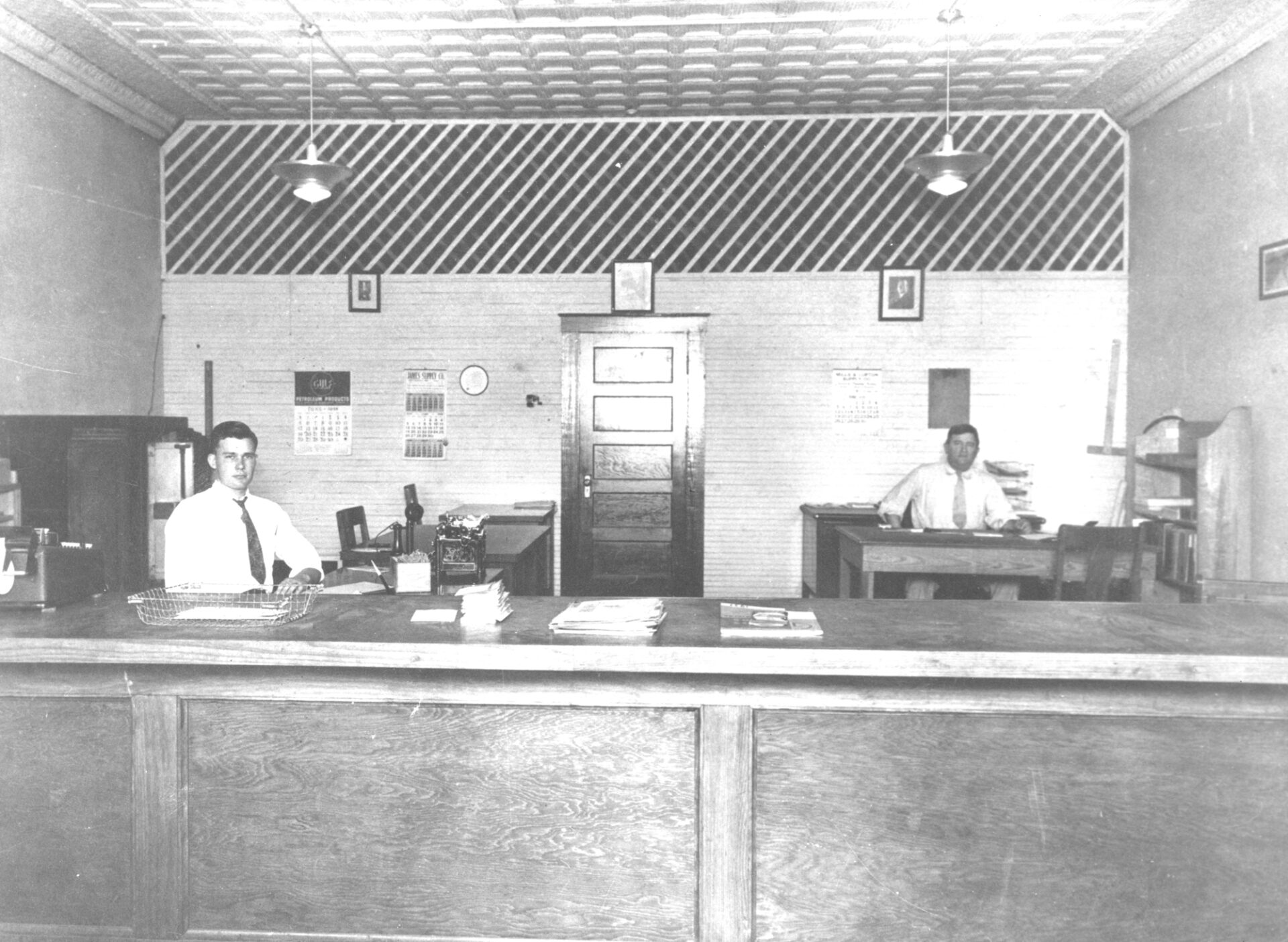
NGEMC’s first Dalton office opens on North Hamilton St. Dealers display electric appliances in the front windows.
August 5, 1937
First Annual Meeting
The first Annual Meeting is held.
At the end of its first year, NGEMC has built 437 miles of line and serves 1,766 members.
August 5, 1937
W. L. Manton
W. L. “Bill” Manton becomes the third General Manager of the Cooperative. Unlike predecessors John H. Graham and John E. Thigpen, Manton serves in the role for over three decades.
September 1, 1939
Throughout it's history, war will have a pattern of slowing the growth of NGEMC throughout Northwest Georgia.
January 31, 1940
A snowstorm dumps 18 inches of snow in Lafayette, GA.
To restore power, one crew shovels snow from the roadways to move their bucket truck down the highway. Eventually, they borrow a mule, which employee Dutch Brown rides to inspect the lines.
December 7, 1941
"A Date Which Will Live in Infamy"
The Japanese Imperial Navy bombs Pearl Harbor. The U.S. enters WWII shortly thereafter.
Several NGEMC employees and their family members are called to serve.
June 30, 1946
At the end of its first decade, NGEMC serves 8,048 members and has 808 miles of line. WWII slows growth in the area.
Before the Cooperative finishes its second decade, growth is again slowed by the outbreak of the Korean War in 1950.
June 30, 1948
The Cooperative builds its first headquarters building at 301 N. Selvidge Street in Dalton, GA.
The cost to build the 17,000 square foot facility is $100,000.
January 1, 1950
Two-way radios for communication with NGEMC offices and crews are in service.
June 30, 1956
At the end of its second decade, NGEMC has 17,782 members and 1,930 miles of line.
March 2, 1960
An ice storm knocks power out across NGEMC’s service territory.
Full restoration takes two weeks in some areas, with line workers cutting limbs by hand in below-zero temperatures.
July 20, 1969
Apollo 11 lands on the moon.
July 15, 1971
The current headquarters office is dedicated at 1850 Cleveland Hwy.
June 30, 1972
Elvin J. Farrar becomes the fourth General Manager of NGEMC.
April 3, 1974
During the two-day Super Outbreak of 1974, and F4 tornado carves a path of destruction 29.5 miles long through Gordon, Murray, and Whitfield counties. It is one of 148 tornados associated with the storms. The tornado which struck the NGEMC area claimed nine lives.
September 2, 1976
Ground is broken on the Trion office.
January 1, 1980
A Leap into the Digital Age
SCADA (System Control and Data Acquisition) is implemented at NGEMC.
November 22, 1985
A ribbon cutting is held for a new Calhoun office.
June 30, 1987
At 50 years, NGEMC serves 60,472 members. For the fiftieth anniversary, Cooperative historian Mark Pace publishes the definitive history of NGEMC, Out of a Dim Era, in 1986.
January 1, 1991
Ron Hutchins becomes the fifth top-executive of the Cooperative in January. He is the first to hold the title of "President and CEO."
March 13, 1993
The storm dumps 22 to 24 inches of snow across NGEMC’s service area. 65,000 members lose power, 411 poles are lost, and total damages cost $2.5 million.
October 4, 1995
Hurricane Opal strikes NGEMC’s system leaving 52,000 members without power. 18 of 22 substations go out of service. The cost of restoration reaches $585,000.
June 30, 2000
www.ngemc.com
NGEMC’s first website is launched.
October 5, 2006
North Georgia Electric Membership Foundation is established.
Collections for the Operation Round Up program begin in the following year.
April 27, 2011
An EF- 4 tornado wreaks havoc on the region, causing tremendous damage and claiming 8 lives in Ringgold, GA.
The event levels 24 miles of line, 27,000 are left without power, and 370 poles are broken. $4 million in damage impacts the NGEMC system.
October 21, 2011
Deployment of AMI (Automatic Metering Infrastructure) meters to all NGEMC members ushers in an era of advanced automation and reporting.
August 1, 2013
Kathryn West takes the helm as the sixth top executive of NGEMC. She is the second President and CEO and first woman in the Cooperative’s top role.
October 30, 2017
North Georgia EMC adds its 100,000th metering point, which is located in Catoosa County -- where it all began back in 1936.
March 11, 2020
In March of 2020, COVID-19 is classified as a global pandemic, the first in NGEMC’s history.
The pandemic changes many operations at the cooperative. Lobbies close to the public, office employees work remotely for the majority of the year, and operations team members and line crews work in isolated small groups.
April 12, 2020
On April 12, a series of severe storms, including three tornadoes, sweep through NGEMC’s service area. The resulting damage leaves 26,000 households and businesses without power.
172 poles are broken and miles of line are torn down. Seven lose their lives in the aftermath of the storm. Crews work around the clock for four days to restore the outages.