Learn How Your Billing Works
Learn more about your North Georgia EMC bill and what your charges mean. Hover over an area on the interactive bill below for more details.
Account Number
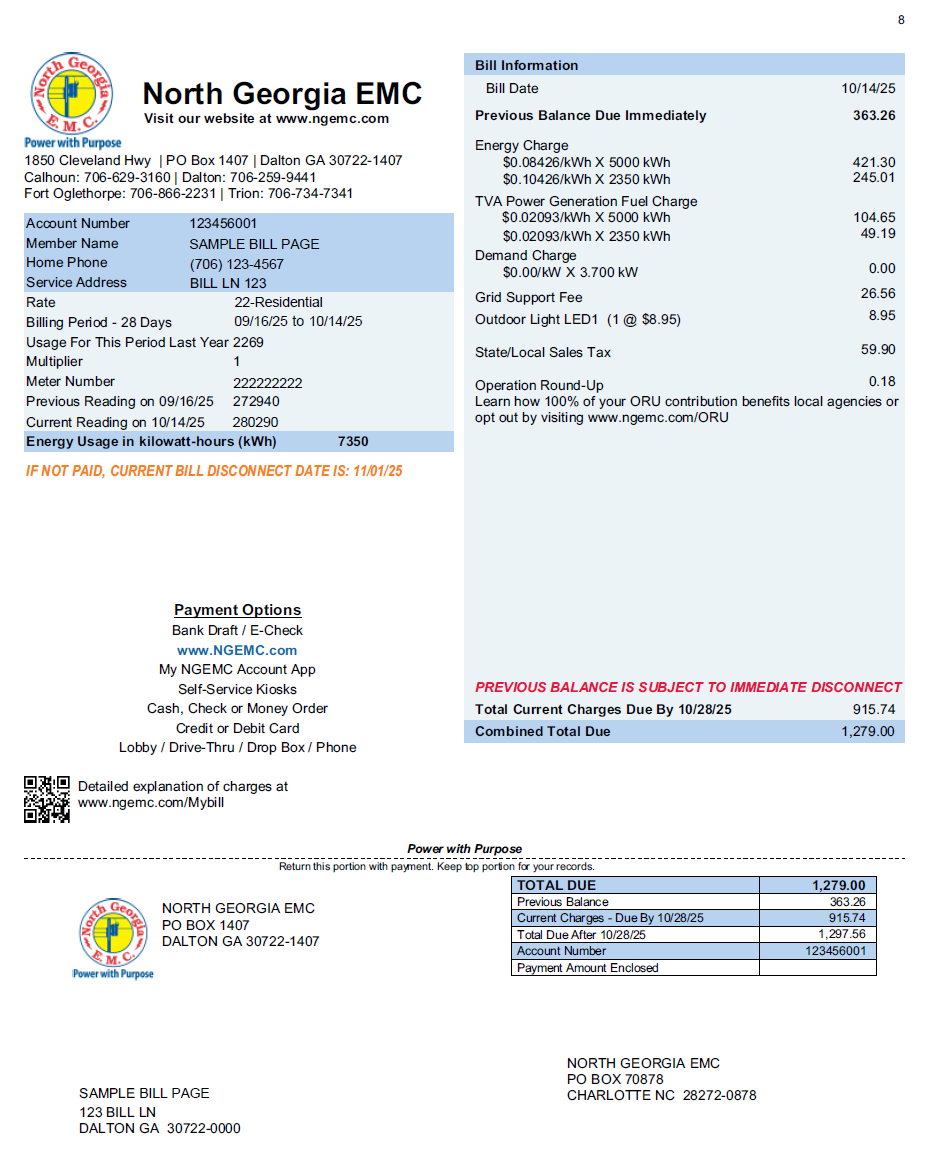
Account Number is a unique number assigned to you and your serviceable address. For faster service, please refer to this number when communicating with North Georgia EMC Customer Service Representative(s).
Payment Options
This gives you a list of available payment options.
Bill Date
Bill Date is the date that your statement was processed by North Georgia EMC Billing Department.
Member Name
Home Phone
Service Address
Serviceable Address is the location to which service is provided.
What do I owe?
This is the total of your past due balance plus your current month's usage.
Due Date
This is the due date for current charges.
Disconnect Warning
Date that service will be disconnected if member does not pay bill.
Energy Usage
Energy Usage is measured in kilowatt-hours (kWh) and used to calculate your bill.
Meter Number
Billing Period
Energy Charges
The Energy Charge is the amount of kWh multiplied by the kilowatt-hour rate. The majority of this charge is used to pay for the energy generated by TVA. Visit our rates page for calculation sheets that explain exactly how your bill is totaled.
Operation Round Up
Through Operation Round Up, NGEMC members can contribute funds to community development initiatives in Catoosa, Chattooga, Floyd, Gordon, Murray, Walker and Whitfield counties.
Previous Balance Due Immediately
This was the balance owed on the account before the current bill was issued. If you have not made a payment or arrangement for this amount, please do so immediately to avoid service interruptions. For questions or to check your current balance, please give us a call at any office or log in to your account online.
Demand Charge
Think of your Energy Usage (kWh) as the odometer on your car, measuring how "far" you go in a month; your demand can be compared to the speedometer. It measures the highest amount of energy used at a given time. (Think of a day spent at home running your clothes dryer, dishwasher, television, etc. all at once having a "high speed" compared to how much energy you use while you are at work being the "low speed.")
Using a lot of energy at once creates demand for more energy at the power generation plant. Because energy storage on a large scale is still a developing technology, and because many energy consumers have similar usage patterns throughout the day, high demand puts a strain on resources such as natural gas, nuclear, and coal. These resources can be used at any time, rather than renewable resources such as solar, which don't produce energy during the evening and night when most consumers are home.
The Demand Charge line item is intended to display your highest demand for the month. At this time, the demand charge line serves as a placeholder as we enable the functionality that will eventually display demand usage. For residential accounts, the rate for this charge is currently $0.00/kW. In the future, a cost is expected to be associated with this charge as TVA demand charges to North Georgia EMC increase.
TVA Power Generation Fuel Charge
TVA adjusts this charge monthly in order to cover the cost of fuels used to generate energy and any additional power TVA must purchase from the energy marketplace when TVA can't meet demand. About 76 cents of every dollar NGEMC makes goes to TVA.
ORU Contribution
If this line item appears on your bill, you are currently enrolled in Operation Round Up (ORU). Visit our ORU page to learn more.
Grid Support Fee
As of August 2025, NGEMC bills have been updated to reflect a name change: What was previously named "System Support Fee" is now "Grid Support Fee."
- Nothing changes for you — all residential members still pay the same flat fee, but the name was changed to better reflect its purpose: Helping NGEMC maintain the equipment and lines that serve power to your home.
- Every member requires the same access to reliable electricity provided by a system of regular maintenance, engineering and operation of the distribution lines, substations, metering, cybersecurity, physical security, and customer support. The Grid Support Fee is designed to reflect these recurring costs for access to reliable energy.